

How to write your own wedding vows: A simple guide
Updated: Sep 21
Writing your own wedding vows is a wonderfully personal way to tell your fiancée what marrying them means to you. However, one blank page and a blinking cursor later, and suddenly every word feels either too much or not enough.
Luckily, great vows don't come from talent or writing experience. They come from following a simple process of saying what's true, then editing it until it feels most like you.
Below, we walk you through this process. By the end, you’ll know how to write memorable wedding vows that come from the heart that also feel natural to say out loud.

A step-by-step guide to writing wedding vows
The easiest way to write your wedding vows is to work in stages, not all at once. Here's the process:
Write freely, without editing. Set a timer for ten minutes and get down everything that comes to mind: memories, feelings, hopes for the future. This messy first draft takes the pressure off getting it right and gives you a rough sense of what you want to say.
Identify your two or three most important promises. Look back through what you wrote and pull out any hidden promises: the specific things you want to commit to, like making time for each other, supporting their career, or being honest even when it's hard. Pick two or three that matter most. These become the backbone of your vows.
Open with why you love this person. One or two sentences is plenty. Think about what drew you to them, or what you love about who they have become today, and say it plainly. "I fell for you because you make even ordinary days feel like an adventure" does more work than a string of generic adjectives.
Move into your promises. Turn the two or three promises from step two into sentences specific to your relationship, not ones anyone could make to anyone. "I promise to be in the front row for every one of your ideas, even the ones that scare you" means more than a vague pledge to always support them. This is the heart of your vows, so give it the most space.
Close the vows with a forward-looking statement. Point your guests and your partner toward what's ahead. It doesn't need to be grand: a promise to keep choosing each other on ordinary days as much as big ones works just as well.
Read them aloud. A sentence that looks fine on the page can be a mouthful when spoken, so read your draft aloud, first to yourself and then to a trusted friend. Notice where you stumble or run out of breath. Those are your cues for what to fix.
Edit for length. Cut any sentence that isn't doing real work, and watch for repetition. Check in with your partner on timing, so you're both aiming for similar length vows.
Practise until they feel natural. Read your vows aloud until you know them without relying on the page. You don't need word-for-word recall, and it's fine to read from a card on the day, but the more familiar they feel, the more you'll be able to look up and actually be present in the moment.

What should you include in your wedding vows?
Good vows usually cover four things: a statement of love, specific promises, something personal, and a look to the future:
Start with the statement of love, explaining why you're marrying this person in your own words.
Move into specific promises, using personal language rather than generic phrases.
Add a personal touch, such as a shared memory or a quality you adore.
Finish with a forward-looking promise about the life you're building.
What not to include in your wedding vows
Your vows should be affectionate, clear, and short enough to hold the room. Here's what to avoid to make sure you keep the moment sincere:
Skip inside jokes most guests won't understand, and avoid anything that might embarrass your partner.
Don't make generic promises you can't keep, however romantic they sound.
Keep humour light. A joke or two is fine, but don't let it tip into a stand-up routine.
3 wedding vow examples
These snippets give you a feel for how to create different types of wedding vows based on tone and personality.
Heartfelt: “I promise to be your steady hand when the world feels chaotic, and your best friend on every ordinary day. I choose you today, and I'll keep choosing you every day after.”
Playful: “You still don't get my love of terrible puns, and I still can't cook, but somehow we work. I promise to laugh with you, learn with you, and save you the last slice.”
Simple and sincere: “I promise honesty on the hard days and gratitude on the easy ones, and to never stop being curious about who you are.”
Your wedding vows should be personal to you; use these as a starting point rather than a script.
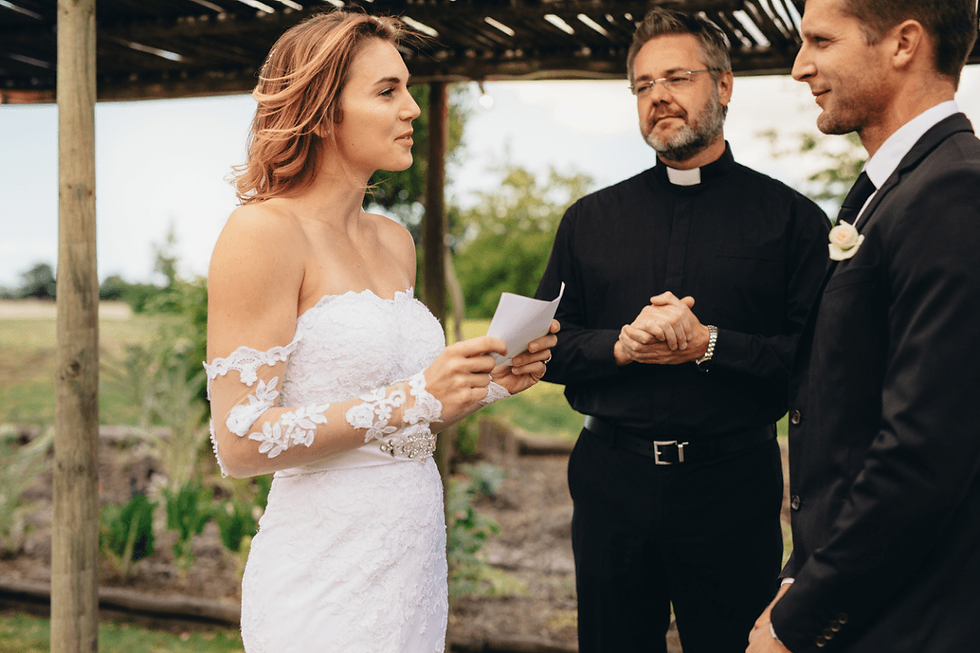
FAQs about writing your own wedding vows
Can you write your own wedding vows?
Yes, most couples can write their own vows. However, what you can include depends on your ceremony type:
Civil ceremonies must include a legal declaration and cannot contain religious content.
Celebrant-led ceremonies offer full creative freedom.
Church weddings usually follow a prescribed structure, though some denominations allow personal additions.
Find out more about the difference between church weddings vs civil ceremonies.
How long should wedding vows be?
Aim for one to two minutes spoken aloud, around 150 to 250 words. Read them aloud with a timer, and compare notes with your partner so your vows are matched.
Can you write your own vows at a civil ceremony?
Yes, but the legal declaration is non-negotiable, and your registrar will advise on the exact phrasing. Beyond that, you can personalise your words, as long as they stay free of religious content.

Ready to say “I do”? Take a look at The Lawrence
Before you can write your vows, you need somewhere to say them.
If you're still searching for a venue, The Lawrence hosts both civil ceremonies and celebrant-led weddings. Whatever shape your vows take, we can help you plan the perfect day.
Explore our wedding venue in Lancashire to see how we could be the backdrop for your perfect wedding.


I liked the simple explanation and useful points shared in this article. I tried Tunnel Rush 2 Online and found the changing obstacles interesting. Some barriers leave only a small space to pass, so quick decisions are useful. Staying focused can help players get farther.